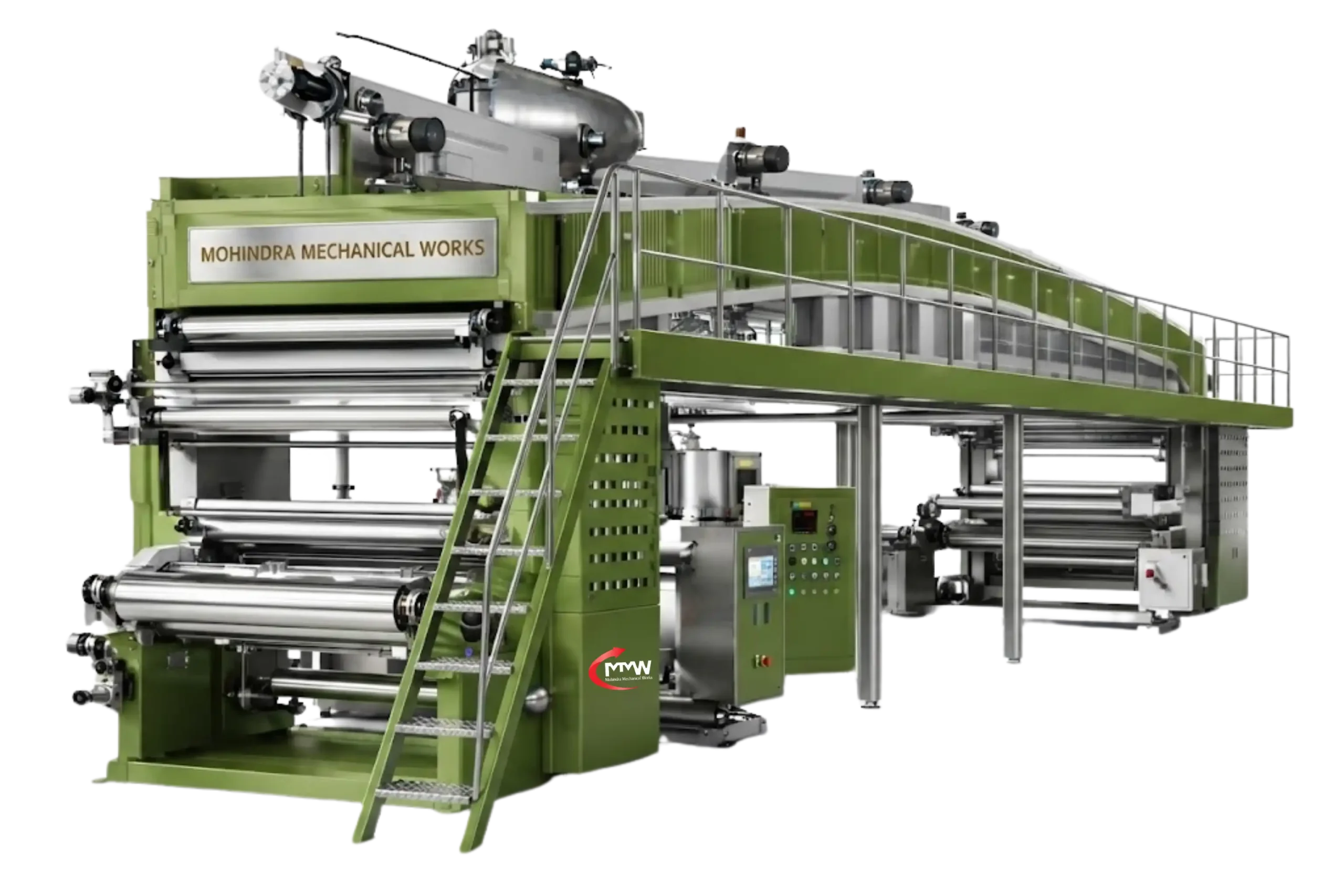
Platinum Paper Coating Machine
Specialised coating system for producing smooth, consistent and premium platinum-finish paper.
The Platinum Paper Coating Machine is used to coat the paper with the formulated coating to achieve a metallic finish. The precise measurement of the coating and drying ensure the uniformity of the color tone, surface smoothness, and visual appearance.
Request a Quote
Contact us today for machine specifications, pricing, and customized solutions.
High-Precision Coating for Premium Platinum-Finish Paper
The manufacture of platinum finish paper calls for careful control of the thickness of the coating, the distribution of the shade and the drying process. Any variations across the width of the paper may be seen as streaks, dull areas, colour differences or a metallic appearance. The Platinum Paper Coating Machine is designed to apply compatible decorative coating formulations to paper on a continuous roll-to-roll basis.
The coating section distributes the prepared compound evenly and the drying system removes the required moisture or carrier under controlled conditions. This application is concerned with the visual character of the paper and not, as with conventional protective coating, with its strength. The machine must maintain the desired platinum tone, smoothness and reflective appearance without making the paper too stiff or unsuitable for subsequent converting.
Designed for Further Paper Converting
After coating the platinum-finish paper may be printed, slit, sheeted, die-cut, folded, pasted or bagged. The completed layer must thus offer the desired appearance without unduly impairing paper elasticity or conversion performance.
The machine applies only the coating level required for the intended finish. This controlled drying eliminates retained moisture, surface adhering and other circumstances that can generate issues at later stages of production.
Buyers should additionally examine ink adherence, adhesive compatibility, folding behaviour and cracking resistance according to the anticipated final product.
Developed Around Metallic-Tone Coating Behaviour
Decorative coating compositions with metallic effect pigments act otherwise than normal water-resistant or adhesive coatings. Even with the same recipe, the final tint can change due to pigment movement, viscosity variation and uneven application.
The machine is consequently designed to control:
- Paper tension
- Formulation transfer
- Applied coating weight
- Coating distribution across the web
- Rewinding condition
- Drying time
- Drying temperature
Coating method selection depends on the formulation viscosity, pigment characteristics, base-paper absorbency and required surface effect.
Maintaining Shade Consistency Across the Roll
Platinum finish papers’ application is mostly due to aesthetics. It is possible that the roll may be properly coated but ultimately not accepted because the color or the reflective nature of the coating may change from the start of the roll to the end.
The proper mixing and application of the coating are crucial in ensuring consistency. Too much coating might result in the darkening of the paper or slow drying or high cost of production. Too little coating might make the underlying paper apparent.
Base Paper Selection Matters
The same coating composition may give varied outcomes on different grades of paper. Surface porosity, moisture level, smoothness and size determine how the coating distributes and how much of it enters the paper structure.
A highly absorbent paper may require additional coating to achieve the intended shade, whereas a smooth, well-sized surface may retain more coating on top. Incorrect base-paper selection can lead to higher consumption without delivering a better finish.
Before machine finalisation, trials should be conducted using the actual base paper and intended formulation. This makes it easy to assess the coat weight, drying required, flexibility and finishing shade under actual settings.
35+ Years of Manufacturing Experience
Precision Engineering & Quality Manufacturing
Customized Machine Configurations to Your Needs
Fast and Reliable After-Sales Support
Platinum-Finish Paper Applications
- Craft and Specialty Paper : Provides a distinctive finish for paper-based decorations, displays and creative products.
- Paper Bags : Suitable for compatible decorative paper used in premium retail and gift-carry bags.
- Decorative Box Covering : Used for rigid boxes manufactured for jewellery, cosmetics, confectionery and luxury merchandise.
- Gift-Wrapping Paper : Creates an attractive surface suitable for high-value gift wrapping and presentation products.
- Invitation and Wedding Card Paper : Produces decorative paper for invitations, envelopes, card inserts and other premium stationery.
- Premium Packaging Paper : Used for wrapping, box covering and packaging products requiring a refined metallic-tone appearance.
Key Features
- Stable Low-Tension Web Handling : Paper movement is controlled to reduce wrinkles, stretching and edge movement during coating.
- Clean Surface Development : Proper application and drying help achieve a smooth surface without excessive coating build-up.
- Controlled Rewinding : The finished paper is rewound with suitable tension to help avoid loose rolls, telescoping and surface marking.
- Multi-Zone Drying Control : Where configured, separate drying zones allow the temperature and airflow profile to be managed according to production requirements.
- Uniform Cross-Web Distribution : Coating is distributed across the working width to help prevent uncoated edges, lines and visible patches.
- Controlled Coating Metering : The application system maintains the required coating deposit to reduce shade and thickness variation.
Frequently Asked Questions
Uneven moisture removal, excessive heat, one-side coating and unsuitable base-paper conditions can contribute to curling.
A both-side coating arrangement may be developed if required. The process depends on the paper, coating chemistry and desired production sequence.
Compatible coated, uncoated, decorative and packaging paper may be processed. Final suitability depends on GSM, absorbency, surface strength and the intended formulation.
Metallic-effect pigments may settle during production. Proper formulation circulation or mixing helps maintain a more consistent pigment distribution.
The final shade depends mainly on the formulation, applied coating weight, base-paper colour and drying conditions. Machine settings can be adjusted within the selected system’s working range.
The correct method depends on formulation viscosity, pigment size, required coat weight and base-paper surface. Gravure, reverse-roll, Mayer bar or another suitable system may be considered after trials.
Not necessarily. In most commercial decorative applications, “platinum finish” refers to the colour or visual effect. The actual formulation must be confirmed by the paper manufacturer.
It is a paper-converting machine used to apply a compatible decorative formulation that creates a platinum-tone or metallic-effect finish on paper.