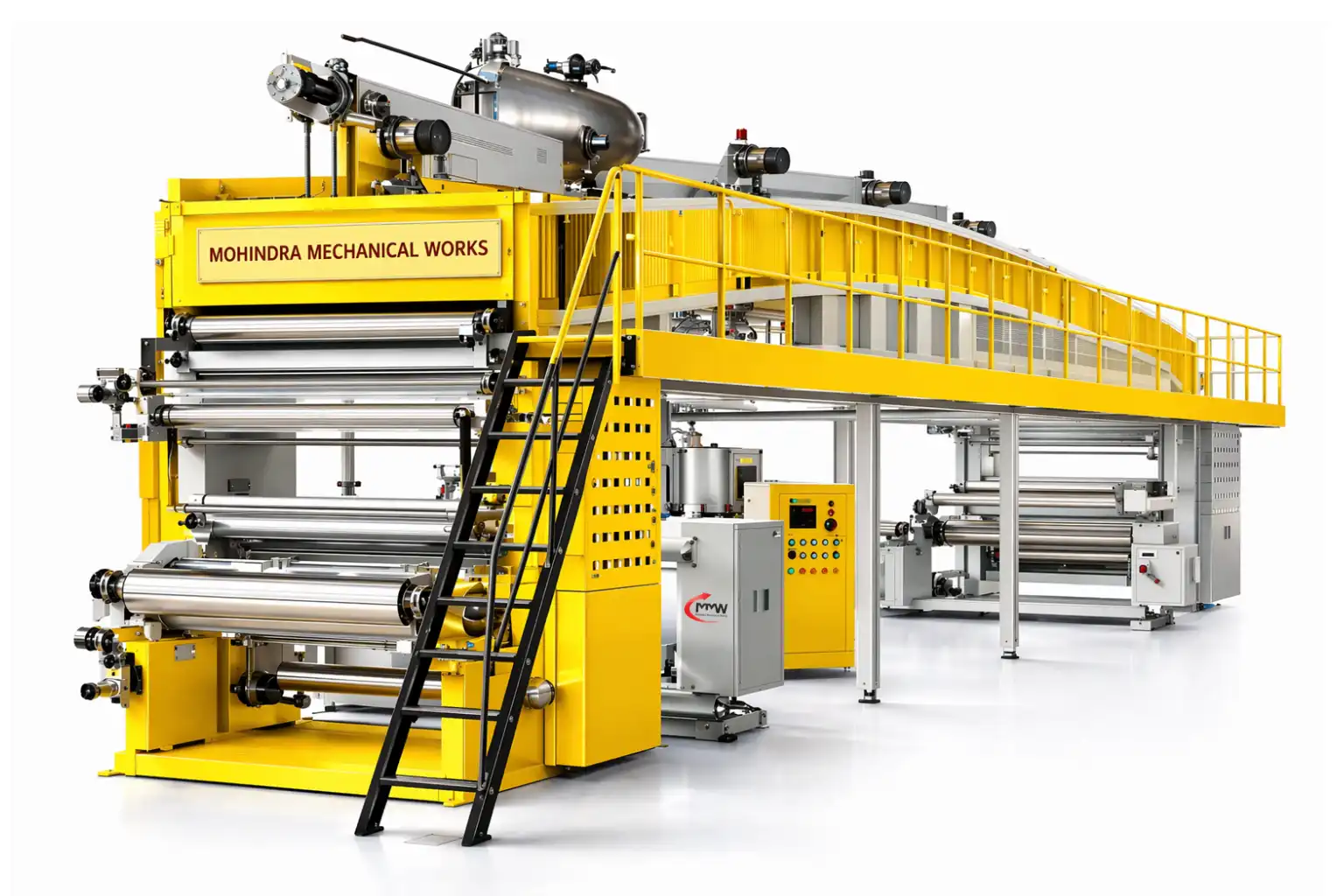
Carbon Paper Coating Machine
Precision coating system for manufacturing clean, smooth and consistent pressure-transfer carbon paper.
Carbon Paper Coating Machine is used to apply the carbon ink formulation on thin paper accurately. The equipment is designed to process thin paper gently and precisely. The machine helps to guarantee even colour transfer and clean reverse side.
Request a Quote
Contact us today for machine specifications, pricing, and customized solutions.
Engineered for Clean, Even and Reliable Carbon Paper Coating
Carbon paper must transfer colour under writing or impact pressure, but must not transfer colour during handling and storage. This balance is achieved through the formulation of the carbon ink and the precision with which it is applied.
The Carbon Paper Coating Machine is developed for the continuous application of carbon ink onto one side of a thin paper web. The coating system applies the formulation to form a smooth layer without excessive penetration, irregular colour density or unwanted coating on the reverse side.
Mohindra Mechanical Works manufactures carbon paper coating systems according to the customer’s base paper, coating formulation, required colour and production capacity. The equipment is configurable for compatible hot-melt or application-specific carbon coating procedures.
Designed for Downstream Converting
After coating, the carbon paper may be sliced, sheeted, printed, collated or made into invoice books and multi-copy stationery. Poorly set coating can transfer onto rollers, cutting equipment or adjacent paper during these operations.
So the cooling and rewinding phases are crucial portions of the manufacture. The coated layer has to be stable enough before winding of the roll, while the winding tension has to be low enough to avoid undesired pressure transfer inside the roll.
This helps prepare the material for cleaner and more efficient downstream converting.
The Challenge of Coating Thin Carbon Base Paper
Carbon base paper is much lighter and more fragile than normal wrapping paper. It can wrinkle, stretch or tear under unstable tension or sudden changes in speed.
The other issue in production is the permeable structure. The uncoated side will develop spots and streaks if the carbon ink bleeds through. This fault is frequently connected with ink penetration through pores or pinholes in the base sheet. This is discussed as a serious problem in coating thin tissue-based paper in patents for carbon paper manufacture.
The machine therefore requires coordinated control over:
- Coating deposit
- Ink viscosity
- Coating temperature
- Paper tension
- Rewinding pressure
- Cooling or setting
- Web speed
These parameters must be adjusted according to the selected paper and carbon ink formulation.
Balanced Coating for Clean and Legible Copies
A heavier carbon layer may produce stronger transfer or a greater number of usable impressions, but excessive coating might increase smearing, stickiness and material consumption. If the coating is too thin, it is possible to make weak or incomplete copies.
The objective is not simply to make the paper darker. The applied layer must release an acceptable amount of colour when pressure is applied while staying sufficiently stable during cutting, stacking, packing and use.
Controlled coating metering allows manufacturers to strike a balance between:
★ Transfer darkness
★ Clarity of copy
★ Number of impressions
★ Surface cleanliness
★ Coating consumption
★ Handling performance
Final settings have to be made by trials with the real paper and ink formulation.
35+ Years of Manufacturing Experience
Precision Engineering & Quality Manufacturing
Customized Machine Configurations to Your Needs
Fast and Reliable After-Sales Support
Carbon Paper Applications
- Tailoring and Pattern Transfer : Carbon transfer paper can be manufactured for marking patterns on fabric, paper or compatible surfaces.
- Industrial Record Books : Used where production, maintenance or inspection information must be copied manually.
- Banking and Accounting Forms : Produces carbon sheets for compatible vouchers, transaction records and financial documentation.
- Delivery and Transport Documents : Used for challans, delivery records and logistics paperwork requiring immediate duplicate copies.
- Invoice and Receipt Books : Suitable for manual billing books, order pads and other multi-copy stationery products.
- Office and Business Forms : Used between document sheets to produce duplicate handwritten or typed records.
Key Features
- Cooling or Setting Section : The coated layer is stabilised before rewinding to reduce blocking and surface disturbance.
- Coating Equalisation : The metering arrangement helps distribute the formulation smoothly across the working width.
- Adjustable Coating Deposit : The applied layer can be regulated according to the required transfer strength and number of usable impressions.
- Controlled Ink Temperature : For compatible heated formulations, temperature control helps maintain suitable flow and application behaviour.
- One-Side Carbon Coating : The coating system applies the carbon formulation to the required face while helping keep the opposite side clean.
- Low-Tension Paper Handling : The web-control arrangement is developed to handle lightweight paper without unnecessary stretching or tearing.
Frequently Asked Questions
Yes, provided that the machine is configured for the paper’s width, strength, GSM and tension requirements.
Correct formulation, adequate cooling or setting and controlled rewinding pressure help reduce blocking between coated layers.
Black and blue are common, but other colours may be possible using compatible pigments, dyes and formulations.
Yes. The coating deposit can be regulated within the capability of the selected coating system and according to the required transfer performance.
This may be caused by porous paper, pinholes, excessive coating, low viscosity, unsuitable temperature or excessive application pressure.
Yes, the machine can be developed for compatible heated formulations. The heating, coating and cooling arrangement must match the specific ink composition.
No. Carbon paper uses a transferable pigmented coating. Carbonless or NCR paper uses reactive chemical layers that form colour when pressure breaks microcapsules.
Pressure from handwriting, typing or another impact releases part of the coated colour layer onto the sheet placed below it, creating a duplicate impression.
It is an industrial machine that applies a transferable carbon ink formulation onto one side of lightweight paper to manufacture carbon paper.