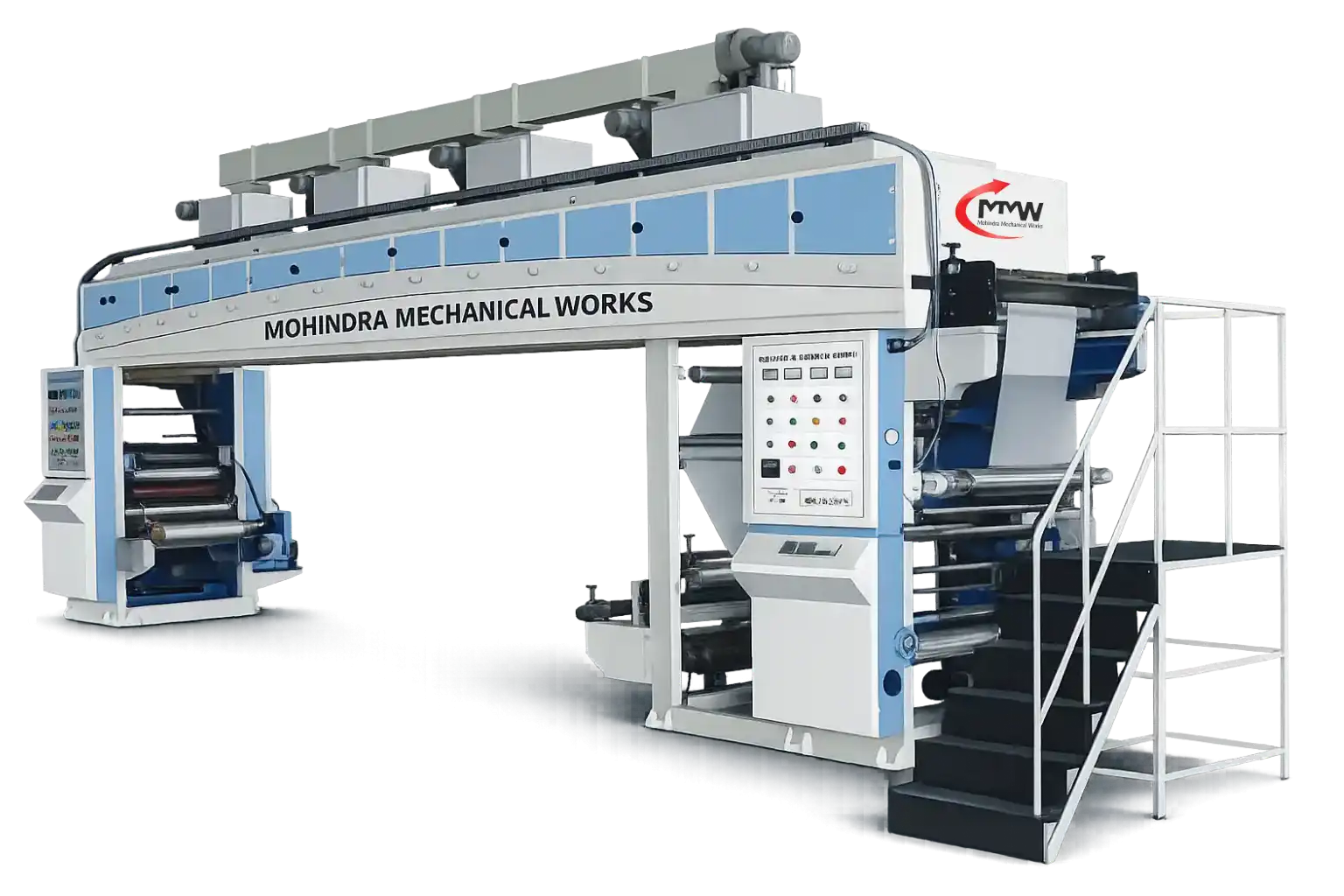
Film Lamination Machine
Precision Lamination for Flexible Film Packaging
The film laminating machine is made for lamination purposes of two or more layers of flexible films which are compatible in order to make multi-layered products for both industrial and packaging use. The machine comprises a combination of even adhesion, proper tension management, accurate web alignment, and adequate lamination pressure.
The film lamination machine is intended for roll-to-roll operations whereby it operates using compatible substrates including PET, BOPP, CPP, PE, and metallized films based on the machine design and the adhesive system used.
Request a Quote
Contact us today for machine specifications, pricing, and customized solutions.
Engineered for Accurate Film-to-Film Lamination
Flexible films can differ substantially regarding thickness, surface properties, and needs for flexibility and tensile strength. Consequently, appropriate controlling of each web becomes very important in order to create a laminate that is even, non-stretched, and free of wrinkles or misalignment.
The Film Lamination Machine controls the web movement from unrolling up to the stage of bonding. Web guiding will make sure that films remain aligned appropriately, while nip pressure will ensure the constant contact of films within the process width. The parameters of production can be changed depending on the type of films and adhesive.
Designed for Smooth Continuous Production
The machine integrates unwinding, coating, lamination and rewinding into a coordinated roll-to-roll process. Where the selected adhesive technology requires drying, an appropriate drying section can also be incorporated before the films are combined.
Controlled web tension helps maintain stable film movement even as roll diameters change during production. After lamination, the finished material is rewound under regulated tension to achieve uniform roll density, proper edge alignment and consistent roll formation, preparing it for subsequent slitting, pouch making or other converting operations.
Why Choose Film Lamination?
A single film may not provide all the characteristics required for a finished packaging structure. Film lamination allows different compatible materials to be combined so that individual layers can contribute properties such as printability, sealing performance, strength, flexibility, appearance or barrier performance.
The lamination process can also protect printed graphics by positioning the printed surface between compatible film layers. This is commonly useful in flexible packaging where both visual appearance and functional performance are important.
A properly configured Film Lamination Machine provides the process control needed to manufacture these multilayer structures consistently across continuous production runs.
35+ Years of Manufacturing Experience
Precision Engineering & Quality Manufacturing
Customized Machine Configurations to Your Needs
Fast and Reliable After-Sales Support
Packaging Applications
- Industrial Film Laminates: Can be configured for selected film combinations used in specialty converting and industrial applications.
- Home-Care Packaging: Suitable for laminated structures used in detergent, cleaning-product and refill packaging.
- Personal-Care Packaging: Produces flexible laminates for compatible cosmetic, hygiene and personal-care packaging applications.
- Metallized Film Packaging: Suitable for compatible film-to-metallized-film structures used for decorative appearance and selected barrier requirements.
- Pouch & Sachet Material: Produces laminated roll stock for subsequent conversion into stand-up pouches, centre-seal packs, sachets and other flexible formats.
- Printed Flexible Packaging: Combines printed film with compatible protective, barrier or sealant layers to create finished packaging structures.
- Food & Snack Packaging: Produces compatible multilayer films for snacks, confectionery, spices, dry foods and other flexible packaging applications.
Key Features
- Uniform Rewinding: Controlled winding supports compact, straight and consistently formed finished rolls.
- Stable High-Speed Web Handling: Helps reduce film stretching, wrinkles and web-tracking variation during production.
- Adjustable Process Parameters: Allows operating conditions to be optimized for different film combinations and adhesive systems.
- Controlled Lamination Nip: Provides uniform pressure and contact between the substrates during bonding.
- Precision Web Guiding: Helps maintain correct film alignment throughout continuous production.
- Accurate Tension Management: Maintains stable web movement while accommodating different film characteristics.
- Uniform Adhesive Application: Provides controlled adhesive distribution across the required working width.
- Multi-Film Lamination Capability: Designed to combine compatible flexible film substrates into multilayer structures.
Frequently Asked Questions
It depends on the adhesive process. Solvent-based or other adhesives requiring drying need an appropriate drying section, while certain solventless processes do not require conventional solvent-evaporation drying.
Flexible films can stretch, wrinkle or shift when tension is not properly controlled. Accurate tension management helps maintain stable web movement, correct alignment and consistent laminate formation.
Yes. Compatible printed film can be laminated with another film to protect the printed layer and provide additional functional properties to the finished structure.
Yes. Different compatible films can be combined when their surface characteristics, adhesive system and processing conditions are suitable for the required laminate.
Depending on machine configuration and adhesive compatibility, the machine can process materials such as PET, BOPP, CPP, PE, metallized films and other suitable flexible substrates.
A Film Lamination Machine is used to bond two or more compatible flexible films into a multilayer structure using an appropriate adhesive and controlled lamination process.