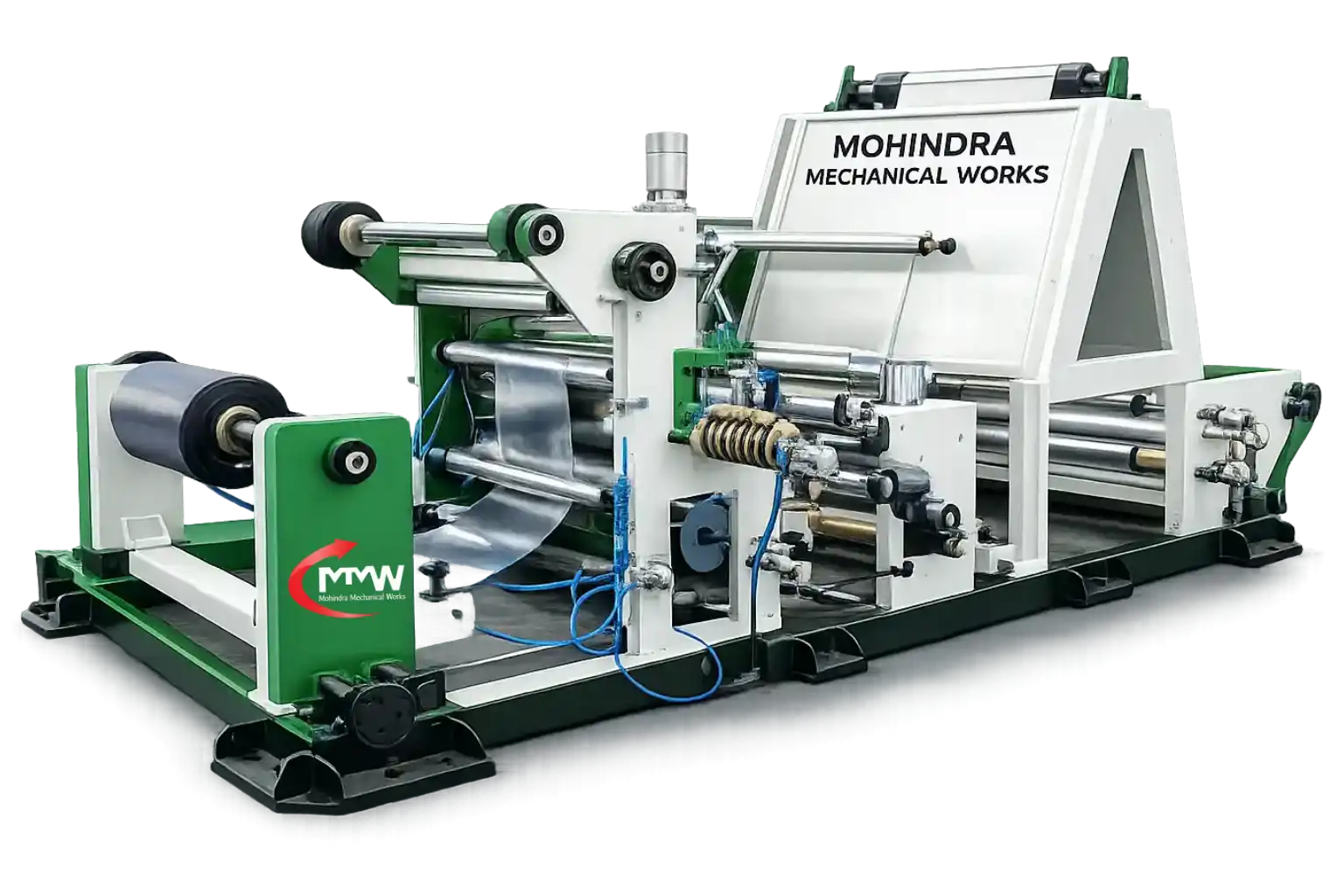
Foil & Poly Lamination Machine
Precision Lamination for Foil and Poly Film Structures
Our Foil & Poly Lamination Machine is specifically engineered to laminate aluminium foil with appropriate polyethylene (PE/poly) film in order to make homogenous laminated materials. It allows one to regulate adhesive application, tensioning and lamination pressure, which is required in order to ensure good bonding of various substrates.
Since the machine operates using continuous roll-to-roll process technology, it helps in careful handling of fragile foil and at the same time ensures constant feeding of poly film.
Request a Quote
Contact us today for machine specifications, pricing, and customized solutions.
Engineered for Delicate Foil Handling
Aluminium foil is a sensitive material that requires careful handling throughout the lamination process. Excessive tension or sudden web movement can cause wrinkles, tearing or edge damage, while poly film may stretch when tension is not properly maintained. The machine uses controlled tension and web-guiding systems to keep both substrates stable and correctly aligned during production.
Before lamination, adhesive is applied uniformly across the required working width. The foil and poly film are then combined under controlled nip pressure, helping maintain even contact and reliable bonding between both layers. Stable material handling also helps reduce wrinkles, misalignment and variations in the finished laminate.
Continuous Foil-to-Poly Lamination Process
The Foil & Poly Lamination Machine is designed for continuous roll-to-roll production, covering the complete process from substrate unwinding and adhesive application to lamination and finished-roll rewinding. Each section operates in coordination to maintain smooth web movement and consistent processing conditions.
Production settings can be adjusted according to foil thickness, poly-film specification, adhesive system and laminate requirements. Where the selected adhesive requires drying, a suitable drying section can be incorporated before lamination. After bonding, controlled rewinding helps produce uniform, compact and properly aligned rolls ready for further converting or packaging operations.
Why Laminate Foil with Poly Film?
Foil and polyethylene serve different purposes in the laminate. While foil is able to give excellent barrier properties, the polyethylene could contribute sealability and flexibility in the laminate.
The combination of these two materials needs precise control due to their different mechanical and surface properties. Correct tension, adhesive coating and lamination pressure are necessary for achieving quality laminates.
The Foil & Poly Lamination Machine would be the suitable machine for this purpose.
35+ Years of Manufacturing Experience
Precision Engineering & Quality Manufacturing
Customized Machine Configurations to Your Needs
Fast and Reliable After-Sales Support
Packaging Applications
- Industrial Foil Laminates: For selected industrial applications requiring aluminium foil bonded with compatible polyethylene film.
- Barrier Packaging: Suitable for laminate structures designed to benefit from the barrier characteristics of aluminium foil.
- Sachet & Pouch Materials: Produces laminated roll stock for subsequent conversion into compatible sachets and flexible pouch formats.
- Pharmaceutical Packaging Structures: Can be configured for selected foil-poly constructions where the materials, adhesive and finished laminate meet the required application specifications.
- Food Packaging: Suitable for appropriate multilayer structures where foil barrier properties and a poly sealant layer are required.
- Flexible Packaging Laminates: For producing compatible foil-poly laminate structures used in selected flexible packaging applications.
Key Features
- Controlled Rewinding: Helps produce compact and uniformly wound finished laminate rolls.
- Configurable Drying System: A suitable drying section can be incorporated where required by the selected adhesive process.
- Accurate Web Alignment: Maintains proper positioning of both substrates before the lamination nip.
- Uniform Adhesive Application: Provides controlled adhesive distribution across the required working width.
- Independent Tension Control: Manages the different web characteristics of foil and poly film during processing.
- Delicate Foil Handling: Regulated web movement helps reduce wrinkles, tearing and unnecessary stress on thin foil.
- Foil & Poly Film Processing: Designed for controlled lamination of aluminium foil with compatible polyethylene film.
Frequently Asked Questions
Yes. The machine can be configured according to working width, foil thickness, poly-film specification, roll dimensions, coating process, drying requirements and automation level.
It can produce foil-poly structures for selected food-packaging applications. The substrates, inks, adhesives and finished construction must meet the applicable food-contact and packaging requirements.
A compatible polyethylene layer can provide heat-sealing functionality. Actual sealing performance depends on the PE grade, laminate construction, adhesive and end-use requirements.
It depends on the adhesive technology. If the selected adhesive requires solvent or moisture removal before bonding, an appropriate drying section is incorporated into the process.
Yes, within the machine's designed operating range. Machine settings are selected according to foil gauge, poly-film specification, adhesive and production conditions.
Thin aluminium foil can wrinkle or tear when subjected to excessive or unstable web tension. Controlled unwinding and tension regulation help maintain smooth foil movement through the machine.
In this application, poly generally refers to polyethylene (PE) film. The exact PE grade and film construction should be selected according to the intended laminate and end-use requirements.
A Foil & Poly Lamination Machine is used to bond compatible aluminium foil and polyethylene film using an appropriate adhesive and controlled roll-to-roll lamination process.