Solvent Base Lamination Machine for Flexible Packaging, Films, Paper and Fabric Applications
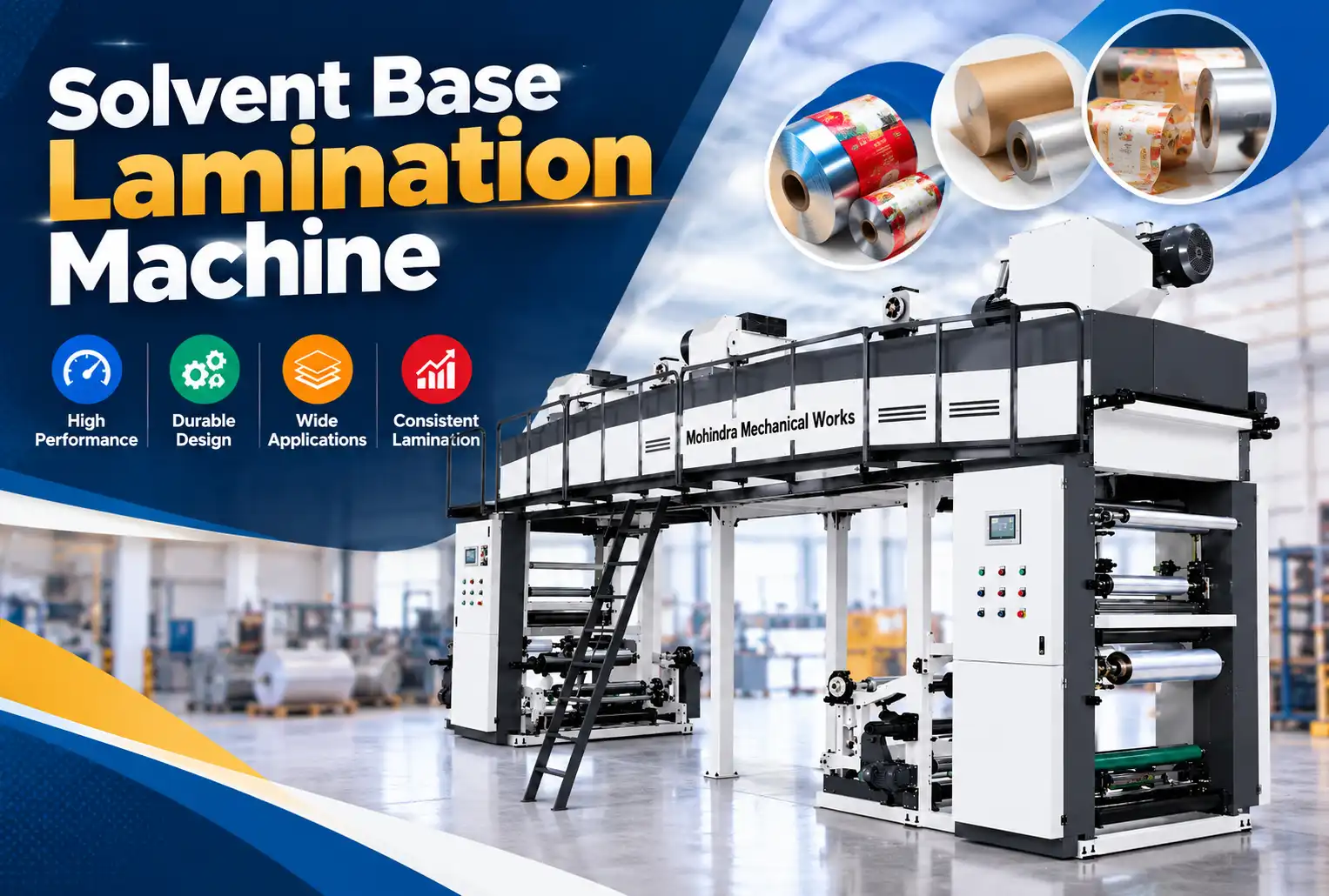
The packaging and converting industry requires reliable lamination technology to combine different materials into strong, durable, and functional structures. A Solvent Base Lamination Machine is widely used for bonding flexible packaging films, paper, aluminium foil, and other compatible substrates with solvent-based adhesives. This technology helps manufacturers produce laminated materials with consistent bonding strength, improved barrier properties, and attractive packaging finishes.
Mohindra Engineering Company manufactures industrial lamination machinery designed to meet the requirements of flexible packaging converters, printing companies, and packaging material manufacturers. Our machines are engineered to support controlled adhesive coating, accurate web handling, effective drying, and uniform lamination across different material combinations.
From food packaging and printed films to industrial laminates, solvent-based lamination technology offers flexibility for manufacturers working with multiple substrates.
What Is a Solvent Base Lamination Machine?
A Solvent Base Lamination Machine is an industrial converting machine that joins two or more flexible materials using a solvent-based adhesive system. The adhesive is applied to one substrate, passed through a controlled drying section to remove solvents, and then bonded with another material under pressure.
This process is commonly known as dry lamination because the adhesive is dried before the two substrates are joined.
The technology is suitable for various packaging structures, including PET/PE, BOPP/CPP, PET/foil, and other compatible combinations. The final laminate can provide mechanical strength, print protection, and barrier performance depending on the selected materials and adhesive formulation.
How Does a Solvent Base Lamination Machine Work?
The lamination process involves several coordinated operations that help maintain consistent product quality.
1. Material Unwinding
The primary substrate is loaded onto the unwinding station. The web passes through tension control and guiding systems to maintain stable movement during production.
2. Adhesive Coating
A controlled quantity of solvent-based adhesive is applied to the substrate through the coating unit. Uniform adhesive distribution is important for consistent bonding.
3. Drying Process
The coated material enters a heated drying tunnel, where controlled airflow and temperature help evaporate solvents. The drying system must be designed with appropriate ventilation and solvent-safety provisions.
4. Lamination Process
After drying, the adhesive-coated substrate is combined with the secondary substrate through the lamination nip. Pressure and, where required, temperature help achieve proper bonding.
5. Rewinding
The laminated material is collected into a finished roll. Depending on the adhesive system, the laminate may require controlled curing before slitting or further converting.
Technical Specifications of Solvent Base Lamination Machine
The following table provides an overview of common technical parameters for an industrial solvent-based lamination system. Exact values depend on the selected machine configuration and production requirements.
| Technical Parameter | Specification |
|---|---|
| Brand Name | Mohindra Engineering Company |
| Machine Name | Solvent Base Lamination Machine |
| Machine Type | Industrial Dry Lamination Machine |
| Application | Flexible Packaging and Industrial Lamination |
| Suitable Materials | BOPP, PET, CPP, PE, Paper, Aluminium Foil |
| Coating System | Gravure Coating / As per Configuration |
| Adhesive Type | Compatible Solvent-Based Adhesive |
| Working Width | Customizable as per Requirement |
| Operating Speed | Depends on Machine Configuration |
| Drying System | Multi-Zone Hot Air Drying |
| Unwinding System | Tension-Controlled Unwinding |
| Rewinding System | Controlled Rewinding |
| Web Guiding | Optional / As per Configuration |
| Heating System | As per Process Requirements |
| Power Supply | Industrial Three-Phase Supply |
| Machine Construction | Heavy-Duty Industrial Structure |
| Automation | Semi-Automatic / Automatic Configuration |
| Country of Origin | India |
| Manufacturer | Mohindra Engineering Company |
Note: The table describes possible configurations rather than verified specifications of a particular MEC model. Final working width, speed, heating capacity, automation, and material compatibility should be confirmed with the manufacturer.
Material Applications of Solvent Base Lamination Machine
One of the important advantages of solvent-based lamination technology is its ability to process different compatible substrates for packaging and industrial applications.
1. BOPP Film Lamination Machine
A BOPP Film Lamination Machine application involves bonding biaxially oriented polypropylene film with suitable substrates. BOPP films are widely used in flexible packaging because of their clarity, dimensional stability, and printability.
Common applications include snack packaging, printed packaging rolls, and laminated pouches.
2. PET Film Lamination Machine
The PET Film Lamination Machine application is suitable for polyester-based packaging structures. PET provides dimensional stability, strength, and good printability, making it a useful outer layer in multilayer packaging.
PET can be laminated with compatible polyethylene, CPP, or aluminium foil structures depending on the end-use requirements.
3. Aluminium Foil Lamination Machine
An Aluminium Foil Lamination Machine application combines aluminium foil with films or paper to manufacture protective packaging structures.
Foil-based laminates are commonly used where moisture, oxygen, or light barrier performance is important, including selected food, pharmaceutical, and industrial packaging applications.
4. Paper to Film Lamination Machine
A Paper to Film Lamination Machine application combines paper with a compatible plastic film to improve selected functional properties such as moisture resistance, strength, and surface protection.
The final properties depend on the paper grade, film type, adhesive, and lamination conditions.
5. Fabric to Fabric Lamination Machine
A Fabric to Fabric Lamination Machine application involves bonding two compatible textile layers for industrial or specialty applications.
Fabric lamination may require dedicated web handling, coating methods, and adhesives because textile surfaces behave differently from smooth packaging films. Suitability should be verified for the specific machine configuration.
6. Fabric to Cloth Lamination Machine
A Fabric to Cloth Lamination Machine application can be used for suitable textile composite structures where controlled adhesive bonding is required.
Material thickness, surface texture, stretch properties, and adhesive selection influence the process. A customized machine arrangement may be necessary for particular textile products.
7. Flexible Packaging Lamination Machine
A Flexible Packaging Lamination Machine is used to manufacture multilayer packaging structures for consumer and industrial products.
Applications can include printed packaging films, food pouches, laminated rolls, and other packaging materials requiring combinations of strength, sealability, appearance, and barrier performance.
Key Features of Solvent Base Lamination Machine
A properly engineered Solvent Base Lamination Machine can offer several advantages for packaging manufacturers.
Uniform Adhesive Coating: A controlled coating system helps distribute adhesive consistently across the substrate, reducing the risk of uneven bonding.
Accurate Web Tension Control: Stable web tension supports proper material movement, alignment, and roll formation during lamination.
Efficient Drying System: A multi-zone drying arrangement can help manage solvent evaporation and adhesive drying under controlled processing conditions.
Heavy-Duty Construction: A rigid machine structure supports stable industrial operation and helps reduce unwanted vibration.
Material Handling Flexibility: Suitable configurations can process different flexible packaging substrates with appropriate settings and adhesive systems.
Controlled Rewinding: Proper rewinding tension helps maintain finished roll quality and prepares the material for subsequent converting operations.
Advantages of Solvent-Based Lamination Technology
Solvent-based lamination remains an important converting process for packaging structures requiring strong adhesion and specialized material combinations.
- Strong Bonding Performance: Compatible adhesive systems can provide high bond strength between different packaging substrates.
- Multilayer Packaging Production: Supports combinations of films, paper, and foil for different functional requirements.
- Print Protection: Reverse-printed films can be laminated to protect printed graphics inside the packaging structure.
- Barrier Packaging Applications: Suitable laminates can help provide moisture, oxygen, and light protection.
- Industrial Production Capability: Automated web handling and process controls support consistent output in production environments.
Performance depends on proper adhesive selection, coating weight, drying efficiency, lamination conditions, and curing.
Industries Using Solvent Base Lamination Machines
Solvent-based lamination systems serve several industrial sectors where multilayer materials are required.
| Industry | Typical Applications |
|---|---|
| Food Packaging | Snack Packs, Dry Food Packaging, Laminated Pouches |
| Pharmaceutical Packaging | Compatible Foil and Film Laminates |
| Flexible Packaging | Printed Film Rolls, Multilayer Pouches |
| Paper Converting | Paper and Film Composite Materials |
| Textile Industry | Selected Fabric Lamination Applications |
| Industrial Packaging | Protective Laminates and Composite Rolls |
| Consumer Goods Packaging | Detergent, Personal Care and Household Product Packs |
The suitability of a laminate for food or pharmaceutical contact must be evaluated against applicable regulations and the specifications of the complete material and adhesive system.
Why Choose Mohindra Engineering Company?
Mohindra Engineering Company is an Indian industrial machinery manufacturer serving the printing, coating, lamination, and converting sectors.
Our engineering approach focuses on providing machinery solutions based on production requirements, material combinations, and the intended application.
Industrial Machinery Expertise
Our product portfolio covers printing machines, coating machines, lamination machines, and slitting and rewinding equipment for packaging and converting industries.
Application-Oriented Solutions
Different packaging materials require different process conditions. Machine configuration can be selected according to substrate properties, adhesive requirements, coating needs, and production capacity.
Focus on Machine Reliability
Industrial lamination equipment requires stable web handling, accurate mechanical alignment, dependable drying, and consistent operation.
Customized Machinery Requirements
Working width, production speed, coating configuration, unwinding, rewinding, and automation requirements can be discussed based on the customer’s application.
Important Factors Before Selecting a Solvent Base Lamination Machine
Before purchasing lamination equipment, manufacturers should consider the materials being processed and the required finished product.
Material Compatibility: Identify whether the machine will process PET, BOPP, CPP, PE, paper, foil, or specialized materials.
Production Requirements: Determine the required working width, target operating speed, and expected production volume.
Adhesive System: Select an adhesive compatible with the substrate combination and end-use application.
Drying and Solvent Handling: Evaluate drying capacity, exhaust ventilation, solvent recovery or treatment requirements, and appropriate fire and explosion protection measures.
Automation Requirements: Consider the need for automatic tension control, web guiding, and other process controls.
Maintenance and Operation: Ensure the selected system allows safe operation, accessible maintenance, and reliable production.
Frequently Asked Questions
Q1. What is the main purpose of a solvent base lamination machine?
It is used to bond two or more compatible flexible substrates using solvent-based adhesives to produce multilayer packaging and industrial laminates.
Q2. Which materials can be laminated using this machine?
Common materials include BOPP, PET, CPP, PE, paper, and aluminium foil. Other materials may be possible depending on the equipment and adhesive system.
Q3. Is solvent-based lamination suitable for food packaging?
Yes, it is used in food packaging manufacturing. However, the adhesive, substrates, curing conditions, and finished laminate must meet the applicable food-contact requirements.
Q4. Can the same machine laminate fabric and plastic films?
Some customized systems can handle both, but fabric processing may require different coating, tension, and handling arrangements. Material trials and technical confirmation are recommended.
Q5. What is the difference between solvent-based and solventless lamination?
Solvent-based lamination uses an adhesive containing solvents that must be removed through drying before bonding. Solventless lamination generally uses adhesive systems without a solvent evaporation stage.
Q6. Can a solvent base lamination machine be customized?
Industrial lamination systems can be configured for different working widths, substrate combinations, coating arrangements, and automation requirements.
Conclusion
A Solvent Base Lamination Machine is an important solution for manufacturers producing flexible packaging and multilayer industrial materials. By combining controlled adhesive coating, effective drying, precise web handling, and reliable lamination, the technology supports the production of quality laminated structures.
Whether the application involves BOPP films, PET films, aluminium foil, paper, or compatible specialty substrates, selecting the right equipment configuration is essential for consistent production.
Mohindra Engineering Company provides industrial machinery solutions for packaging and converting businesses looking to improve their production capabilities.
For product information, technical discussions, and machinery enquiries, visit the Solvent Base Lamination Machine product page.
About info@mohindraengineeringcompany.com
View all posts by info@mohindraengineeringcompany.comSearch
Recent Posts
Categories
- Coating Machine (7)
- Flexo (2)
- Lamination Machine (4)
- Rotogravure (7)