Solventless Lamination Machine for BOPP, PET and CPP Films
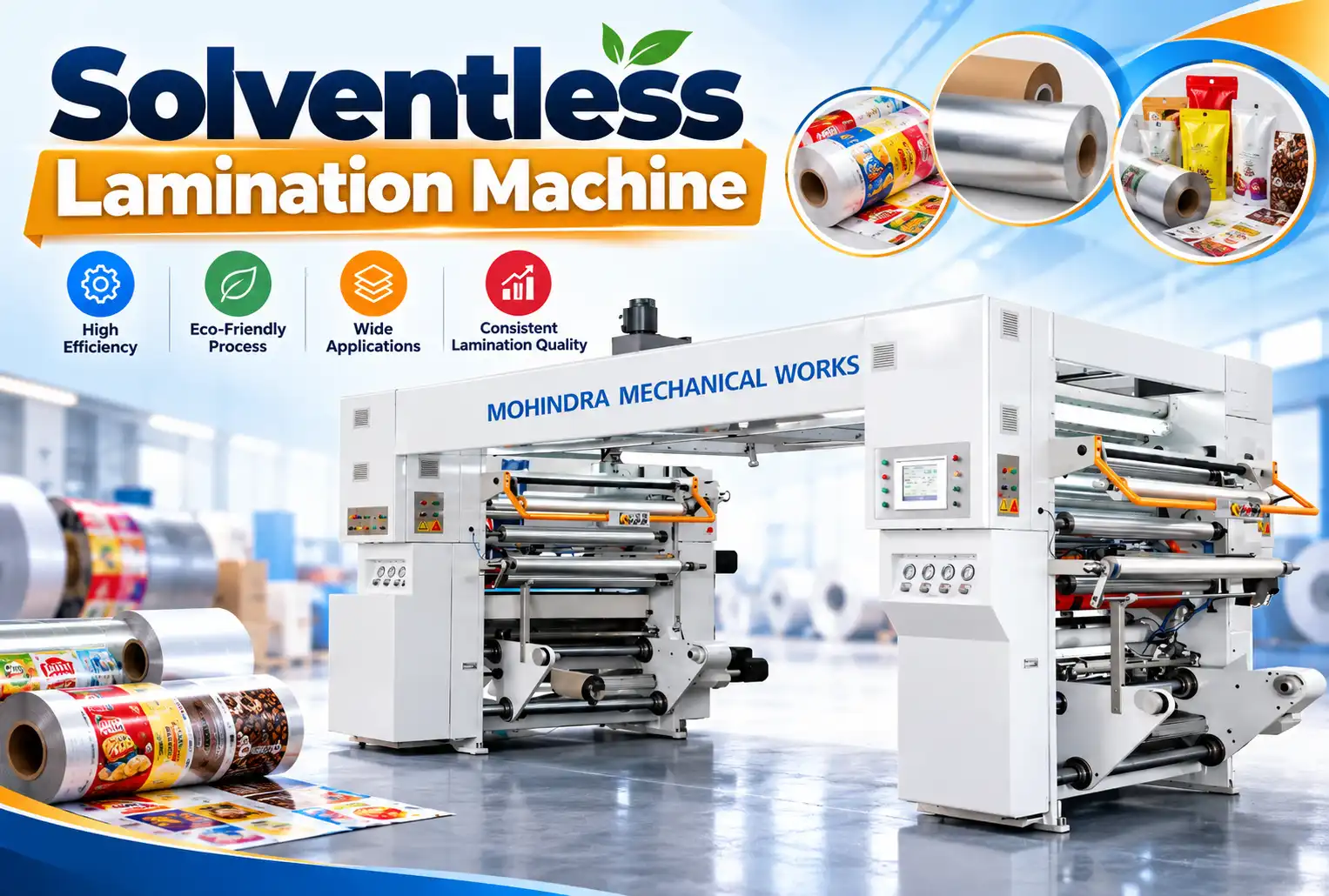
The flexible packaging industry continues to adopt advanced lamination technology to produce durable, lightweight, and high-quality packaging materials. A Solventless Lamination Machine is designed to bond two or more compatible flexible substrates using adhesives that do not require solvent evaporation during the lamination process.
This technology is widely used for laminating BOPP, PET, CPP, PE, and other compatible packaging films. It helps manufacturers produce multilayer packaging structures with controlled adhesive application, consistent bonding, and efficient material handling.
Mohindra Engineering Company provides industrial machinery solutions for packaging manufacturers, printing companies, and flexible film converters. Our focus is on delivering machinery that supports reliable production, accurate web handling, and consistent lamination performance.
What Is a Solventless Lamination Machine?
A Solventless Lamination Machine is industrial equipment used to combine flexible packaging substrates through a solvent-free adhesive bonding process. Unlike solvent-based lamination, solventless technology generally does not require a drying tunnel for solvent removal.
The process commonly uses two-component polyurethane adhesive systems, although adhesive selection depends on the packaging structure and application.
The adhesive is applied in a controlled quantity to one substrate, which is then combined with another material through lamination rollers. The bonded material is rewound and allowed to cure according to the adhesive manufacturer’s recommendations.
This technology is commonly used in food packaging, printed film lamination, multilayer packaging, and industrial flexible packaging applications.
How Does a Solventless Lamination Machine Work?
The solventless lamination process involves several coordinated operations to achieve consistent adhesive bonding and finished roll quality.
1. Material Unwinding
The primary substrate is loaded onto the unwinding station. The material passes through tension control and guiding systems that maintain stable web movement during production.
Proper web handling is important when processing thin films such as BOPP, PET, CPP, and polyethylene.
2. Adhesive Mixing and Application
A compatible solventless adhesive is prepared according to the adhesive supplier’s specifications. Two-component systems require controlled mixing ratios and processing conditions.
The adhesive is applied through a precision coating arrangement to maintain uniform coating weight across the substrate.
3. Film Lamination
The adhesive-coated substrate is combined with a secondary film through the lamination nip. Controlled pressure, web tension, and appropriate temperature help achieve consistent bonding.
4. Rewinding Process
The laminated material passes through the rewinding station, where tension is controlled to maintain proper roll formation and material alignment.
5. Adhesive Curing
After lamination, the finished rolls may require curing before slitting, pouch making, or further processing.
Curing time depends on the adhesive formulation, material combination, coating weight, and operating conditions.
Technical Specifications of Solventless Lamination Machine
The following table outlines common technical parameters and configuration options for an industrial solventless lamination system.
| Technical Parameter | Specification |
|---|---|
| Brand Name | Mohindra Engineering Company |
| Machine Name | Solventless Lamination Machine |
| Machine Type | Industrial Solvent-Free Lamination System |
| Suitable Materials | BOPP, PET, CPP, PE and Compatible Films |
| Lamination Process | Solventless Adhesive Lamination |
| Adhesive System | Compatible One- or Two-Component Adhesive |
| Coating System | Precision Multi-Roller Coating |
| Working Width | Customizable as per Requirement |
| Operating Speed | Depends on Machine Configuration |
| Unwinding System | Tension-Controlled Unwinding |
| Rewinding System | Controlled Rewinding |
| Web Guiding System | As per Selected Configuration |
| Adhesive Mixing Unit | As per Adhesive System |
| Temperature Control | As per Process Requirements |
| Drying Tunnel | Not Normally Required |
| Power Supply | Industrial Three-Phase Supply |
| Automation | As per Machine Configuration |
| Machine Structure | Heavy-Duty Industrial Construction |
| Application | Flexible Packaging and Film Lamination |
| Country of Origin | India |
| Manufacturer | Mohindra Engineering Company |
Note: These are general industry configuration options, not confirmed specifications for a particular Mohindra model. Final speed, width, coating system, automation, and material compatibility should be verified before purchase.
Material Applications of Solventless Lamination Machine
A solventless lamination system can process various flexible packaging substrates when the selected materials and adhesive are compatible.
1. BOPP Film Lamination Machine
A BOPP Film Lamination Machine application involves bonding biaxially oriented polypropylene film with compatible flexible packaging materials.
BOPP film is commonly used in packaging because of its clarity, printability, and dimensional stability.
Typical applications include snack packaging, confectionery wrappers, printed packaging films, and laminated packaging rolls.
2. PET Film Lamination Machine
A PET Film Lamination Machine application uses polyester film as one of the substrates in a multilayer packaging structure.
PET film offers strength, dimensional stability, and good printability, making it suitable for printed outer layers.
Common applications include flexible food packaging, printed film laminates, and selected industrial packaging structures.
3. PET to PE Lamination Machine
A PET to PE Lamination Machine application combines polyester film with polyethylene film to produce packaging structures that benefit from the properties of both materials.
PET can provide strength and printability, while a suitable PE layer can provide heat-sealing properties.
These laminates are used in various flexible packaging applications, depending on the required barrier performance and product compatibility.
4. BOPP to CPP Lamination Machine
A BOPP to CPP Lamination Machine application bonds BOPP film with cast polypropylene film.
BOPP is often selected for its printing and appearance characteristics, while CPP can provide suitable sealing performance.
This combination is used for selected food packaging, confectionery packaging, and printed flexible packaging products.
5. PET to CPP Lamination Machine
A PET to CPP Lamination Machine application combines polyester and cast polypropylene films.
This structure can provide a combination of mechanical strength, printability, and sealing properties.
Material selection and adhesive compatibility depend on the intended packaging application and processing requirements.
6. Film to Film Lamination Machine
A Film to Film Lamination Machine application joins two compatible plastic films to manufacture multilayer flexible packaging materials.
The process is suitable for different film combinations when the adhesive system and equipment configuration support the selected substrates.
Applications include printed packaging rolls, pouch laminates, and industrial flexible packaging.
7. Flexible Packaging Lamination Machine
A Flexible Packaging Lamination Machine is used to manufacture laminated film structures for packaging products across multiple industries.
Suitable laminate structures may combine strength, print protection, sealability, and barrier performance according to the packaging requirements.
Typical applications include food pouches, snack wrappers, personal care packaging, and consumer product packaging.
Key Features of Solventless Lamination Machine
An appropriately configured Solventless Lamination Machine can offer several useful features for industrial packaging production.
Precision Adhesive Coating
A controlled coating arrangement helps maintain uniform adhesive application across the film surface.
Consistent coating weight is important for proper bonding and efficient adhesive usage.
Accurate Web Tension Control
Stable web tension helps maintain film alignment and reduces the possibility of wrinkles during lamination.
Solvent-Free Adhesive Processing
The process uses compatible solventless adhesive systems, avoiding the solvent evaporation stage associated with conventional solvent-based lamination.
Efficient Film Handling
Suitable unwinding, guiding, and rewinding arrangements support consistent movement of thin flexible packaging films.
Controlled Lamination Pressure
The lamination nip helps combine substrates under appropriate processing conditions for uniform adhesive contact.
Industrial Machine Construction
A rigid mechanical structure supports stable machine operation and accurate component alignment.
Advantages of Solventless Lamination Technology
Solventless lamination offers several advantages for packaging manufacturers working with compatible film structures.
- Reduced Solvent Emissions: Solventless adhesives avoid the solvent evaporation associated with solvent-based adhesive systems.
- No Conventional Solvent Drying Tunnel: The process generally does not require a drying tunnel for solvent removal.
- Controlled Adhesive Application: Precision coating systems support uniform adhesive distribution.
- Flexible Film Compatibility: Suitable configurations can process different combinations of BOPP, PET, CPP, and PE films.
- Efficient Production: Proper web handling and process control can support consistent industrial production.
- Multilayer Packaging: The technology supports the production of different laminated film structures.
Actual productivity, energy consumption, adhesive performance, and curing requirements depend on the selected system and production conditions.
Industries Using Solventless Lamination Machines
Solventless lamination systems are widely used in industries that manufacture multilayer flexible packaging.
| Industry | Typical Applications |
|---|---|
| Food Packaging | Snack Wrappers, Dry Food Pouches, Printed Film Packaging |
| Confectionery Packaging | Chocolate Wrappers, Candy Packaging Films |
| Flexible Packaging | Multilayer Laminated Rolls, Packaging Pouches |
| Personal Care Packaging | Shampoo Sachets, Cosmetic Packaging |
| Household Product Packaging | Detergent and Consumer Product Pouches |
| Industrial Packaging | Compatible Film Laminates and Protective Packaging |
| Printing and Converting | Reverse-Printed Film Lamination and Roll Processing |
For food-contact applications, the adhesive and finished laminate must meet applicable regulatory requirements, including appropriate curing and migration limits.
Why Choose Mohindra Engineering Company?
Mohindra Engineering Company is an Indian industrial machinery manufacturer serving the printing, coating, lamination, and converting industries.
The company provides machinery solutions for packaging manufacturers looking to improve production consistency and material processing capabilities.
Industrial Machinery Experience
Our product portfolio includes rotogravure printing machines, coating machines, lamination machines, and slitting and rewinding equipment.
Application-Based Machinery Solutions
Different packaging films require suitable coating systems, adhesive handling, tension control, and processing conditions.
Machine configuration can be discussed according to the material combination and production requirements.
Focus on Production Reliability
Stable web movement, accurate alignment, consistent adhesive coating, and controlled rewinding are important factors in industrial lamination.
Customized Machine Requirements
Working width, operating speed, automation, coating arrangement, and material handling requirements can be evaluated according to the customer’s application.
Solventless Lamination vs Solvent-Based Lamination
Both technologies are used in flexible packaging manufacturing, but their adhesive processing methods differ.
| Parameter | Solventless Lamination | Solvent-Based Lamination |
|---|---|---|
| Adhesive System | Solvent-Free Adhesive | Solvent-Based Adhesive |
| Solvent Evaporation | Not Required | Required |
| Drying Tunnel | Generally Not Required | Required |
| Adhesive Application | Controlled Coating System | Controlled Coating System |
| Curing | Depends on Adhesive | Depends on Adhesive |
| Suitable Materials | Compatible Flexible Substrates | Compatible Flexible Substrates |
| Common Applications | Multilayer Film Packaging | Film, Paper and Foil Laminates |
The appropriate technology should be selected according to adhesive compatibility, substrate properties, packaging performance, and production requirements.
Important Factors Before Selecting a Solventless Lamination Machine
Before purchasing a lamination system, packaging manufacturers should evaluate the following factors.
Material Compatibility
Identify the film combinations required for production, such as PET/PE, BOPP/CPP, or PET/CPP.
Production Capacity
Determine the working width, required operating speed, and expected production volume.
Adhesive Selection
Choose a compatible adhesive system based on material properties, packaging application, and curing requirements.
Coating Accuracy
Evaluate the coating system’s ability to apply the required adhesive quantity consistently.
Web Handling System
Consider the unwinding, guiding, tension control, and rewinding requirements for thin packaging films.
Machine Automation
Review the required level of automation, process monitoring, and operator control.
Frequently Asked Questions
Q1. What is the main purpose of a solventless lamination machine?
A solventless lamination machine bonds compatible flexible substrates using adhesives that do not require a solvent evaporation stage.
Q2. Which films can be laminated using solventless technology?
Common materials include BOPP, PET, CPP, PE, and other compatible flexible packaging films.
Q3. Does solventless lamination require a drying tunnel?
A conventional solvent drying tunnel is generally not required because the process uses solventless adhesive systems.
Q4. Is solventless lamination suitable for food packaging?
Yes, solventless lamination is used in food packaging. However, the adhesive, materials, curing conditions, and finished laminate must meet applicable food-contact requirements.
Q5. What is the difference between PET/PE and BOPP/CPP lamination?
PET/PE combines polyester and polyethylene films, while BOPP/CPP combines biaxially oriented polypropylene and cast polypropylene. Each structure offers different properties depending on the selected grades and packaging requirements.
Q6. Can solventless lamination machines be customized?
Industrial solventless lamination systems can be configured for different working widths, coating arrangements, automation requirements, and compatible film combinations.
Conclusion
A Solventless Lamination Machine is an important solution for manufacturers producing flexible packaging films and multilayer laminated materials. Its solvent-free adhesive process supports controlled coating, consistent bonding, and efficient film conversion.
Whether the application involves BOPP, PET, CPP, PE, or other compatible substrates, selecting the correct equipment configuration is essential for reliable production.
Mohindra Engineering Company provides industrial lamination machinery solutions for packaging manufacturers, printers, and converting businesses.
For machine information, technical specifications, and business enquiries, visit our Solventless Lamination Machine product page.
About info@mohindraengineeringcompany.com
View all posts by info@mohindraengineeringcompany.comSearch
Recent Posts
Categories
- Coating Machine (7)
- Flexo (2)
- Lamination Machine (4)
- Rotogravure (7)